Gregory Fulton looks back on the Making of Heroes III – Exclusive Interview by Riot Pixels 2026
Gregory Fulton, one of the key designers behind Heroes of Might and Magic III, later worked on Command & Conquer: Renegade before leaving the game industry. Around 2020, he began developing Fanstratics, a spiritual successor to Heroes III, but the project was eventually cancelled due to health issues.
Fulton is now working on a book about the making of Heroes III, sharing exclusive insights into the development of this legendary game. In this interview, he discusses his work on Heroes III and the story behind its creation.

Riot Pixels: In your recollections about the development of Heroes 3, you never seemed to mention games that are now considered competitors or at least close in spirit to the Heroes series — Warlords, Age of Wonders, Disciples, Master of Magic.
Some of them were still in development at the time of Heroes 3’s release, while others had already been out for years. Did you not view them as competitors?
Gregory Fulton: I never really considered Warlords and Master of Magic to be direct competition, as they had distinct differences. Age of Wonders and Disciples were closer to what HoMM was doing, but still had their own unique style.
Today, HoMM is experiencing direct competition, from titles like Songs of Conquest and Heroes of Science and Fiction.
RP: Did you ever compare them to your own game?
GF: Of course.
RP: Why do you think RollerCoaster Tycoon was more popular than Heroes 3 in the United States at the time? And why didn’t the same thing happen in Europe?
GF: This is pure speculation on my part, but I suspect the difference is cultural. Different regions have different preferences, typically emerging from their unique culture.
Consider Wizardry, which was more popular in Japan than the rest of the world. Consider StarCraft, which was more popular in South Korea than the rest of the world. Consider HoMM3, which is more popular in Europe and Russia, than the rest of the world.
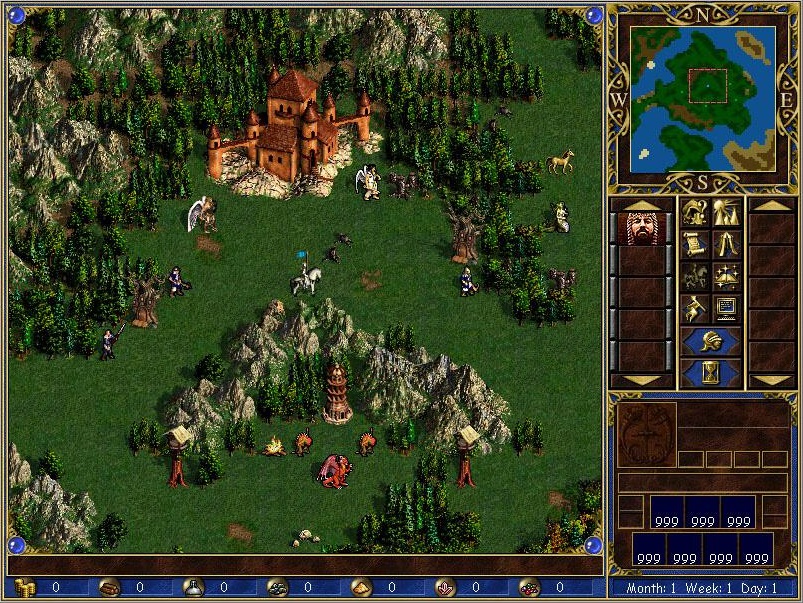
Adventure map beta screenshot
RP: One could even argue that Heroes 3 is significantly more popular now.
GF: You could make the argument, and you would probably be right. Still, RollerCoaster Tycoon, just like HoMM3, continues to be played today. It is also being remade for the modern market.
RP: How did you envision the target audience for Heroes 3 during development, and how do you see it now? For example: did they prefer single-player or hot-seat, maps packed with enemies, or more adventure-style maps where you could play at your own pace without constantly worrying about opponents?
GF: At the time, I envisioned the audience as single-players, preferring ‘free-for-all’ maps. I understood there were people who played ‘hotseat’ and wanted ‘role-playing’ maps, but we estimated at least 80% of the audience wanted single-player, free-for-all experiences. As for today, I don’t think it’s much different, but internet multiplayer gamers do require special considerations.
RP: If an equivalent of Steam Early Access had existed in 1998, would you have used the opportunity to show a rough version of the game to your audience? Would it have benefited the game and New World Computing?
GF: Tough question. Personally, I think the usefulness of ‘early access’ really comes down to the developer, and their ability to envision the game they are making. If they have a rock-solid vision, early access becomes little more than a bug hunt. If they don’t have a well-defined vision, early access becomes design, player, and market research.
As for NWC in 1998, we had a crystal-clear vision for the game we were making, and programming bugs were uncommon. Also, our single map game demo did a good deal of positive marketing. I strongly doubt early access would have been a significant benefit.

Hero Screen beta screenshot
RP: Did you have any specific wishes regarding the music, how it should sound, what mood it should convey, or were those decisions left entirely to Rob King and Paul Romero?
GF: Rob and Paul were completely on their own. They simply delivered the music, and we put it in the game.
RP: In the late 1990s everyone (developers, journalists, players) was obsessed with 3D and this is visible in your recollections as well. Was the possibility of making Heroes 3 in full 3D ever considered? In your opinion, would it have helped the game’s sales? How would it have affected its longevity?
GF: At the time… in 1997… no. HoMM simply required too many objects on screen, and the hardware at the time wasn’t strong enough to render enough polygons at a high frame rate. After 2010, did I think computer hardware was powerful enough to make a 3D version of HoMM. Even then, it would have been tough.
Only now do I think there is enough processing power to properly make the game in 3D, and still there are ‘issues’. Ironically, the video game market seems to have ‘gotten over’ making 3D a necessary game requirement (Hollow Kight, Cuphead, Odin Sphere, Ori and the Blind Forest, etc.). Perhaps it would be best to keep HoMM a 2D game, and just make it the most gorgeous 2D game possible.
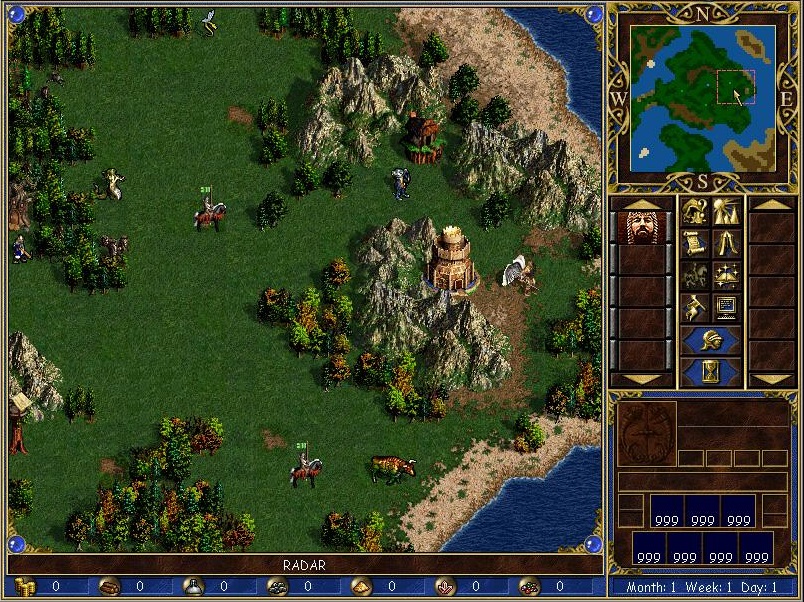
Adventure map beta screenshot
RP: From your recollections one gets the impression that management, especially at 3DO, did not view Heroes 3 as a particularly outstanding or important game. Is that impression correct?
GF: This was my impression. If they did consider HoMM3 outstanding, or important, they never shared it with the team.
RP: Within New World Computing itself, and personally for you, was there an awareness that you were creating something special that people would still be talking about 30 years later?
GF: At the end, we knew the game was good, but the thought of people continuing to play it… 30 years later? We would have laughed at the idea. At the time, for our team, amongst our leads, our only goal was to make a 5-star game.
RP: On some campaign maps in Heroes 3 (for example, the final mission of the Dungeons and Devils campaign) there is a feeling that the scenario becomes significantly easier or harder depending on which spells the player received in the Mage Guild in the current and previous missions (from which heroes were carried over).
A similar situation existed in the Heroes 1 campaign. Were these scenarios designed with the understanding that randomness could either ruin or greatly improve the player’s experience of the mission?
GF: To a degree.. yes. We knew fortunate/unfortunate randomness could greatly affect a player’s experience, and we considered it part of the game.

Battle beta screenshot
RP: What does the ideal Heroes map look like to you? For example, should it be focused on a single-player adventure, or should it be designed primarily for multiplayer? Do you have any personal favorite maps from the Heroes series?
GF: For me? Personally? I like free-for-all maps, against numerous starting opponents, leading to a showdown with me possessing 50% of the map, and one final computer enemy possessing the other 50% of the map. As for a specific, personal favorite map, I can honestly say I don’t have one.
Only on infrequent occasions would I play a specific map more than once or twice. There are so many different company and community maps available, just pick another you haven’t played before… and keep going.
RP: After E3 1998, numerous articles about the game appeared in Russian gaming magazines (of which there were far more back then than there are now). It’s hard to say whether all of them were based on your presentation in Atlanta and conversations with you, but among other things they mentioned “pirate heroes” (supposedly already considered for Heroes 2), that “Heroes 4 is already in development” and that it might be something in the vein of “Heroes in space.”
How accurate is this, and can you recall any other equally wild ideas that were discussed during the development of Heroes 3 or Armageddon’s Blade but never went beyond the discussion stage?
GF: I don’t recall any of this, but I wasn’t the only person who presented HoMM at E3 in Keep in mind, alcohol was also being served, so I wouldn’t be surprised if someone was rambling while intoxicated. Also, my conceptual work on the expansion only began in the week after we shipped.

Castle beta screenshot
RP: In another interview with a Russian magazine it was said that artifacts would give bonuses to some attributes while worsening others. Why was this idea abandoned? (By the way, in that same interview there is a direct quote from you: “we are not working on any other projects at the moment.”)
GF: This specific idea was a holdover idea from HoMM2, and once JVC and I got down to finalizing the artifacts, he didn’t like them and wanted them gone. I agreed. So, we cut them from the game.
RP: In that same interview you spoke about a “branching storyline” and “quests from the Might and Magic 6 team that would influence the further progression of the game.” Did this mean something in the spirit of Heroes 2 campaign, or could the player’s decisions during the campaign lead them toward completely different endings (and maps)?
GF: I honestly do not recall, but I do remember, at some point, wanting to move to smaller campaigns with only 3 or 4 maps. From our anecdotical research, far too many people were not finishing the HoMM2 campaigns.
RP: After Heroes 3 you worked on Command and Conquer: Renegade. How would you characterize working on these two projects: which one was easier to work on, which atmosphere did you enjoy more, and which project did you like better during development?
GF: Each project, and each company, was completely different. HoMM3 was definitely easier and more enjoyable to work on, but Westwood had a more social atmosphere.
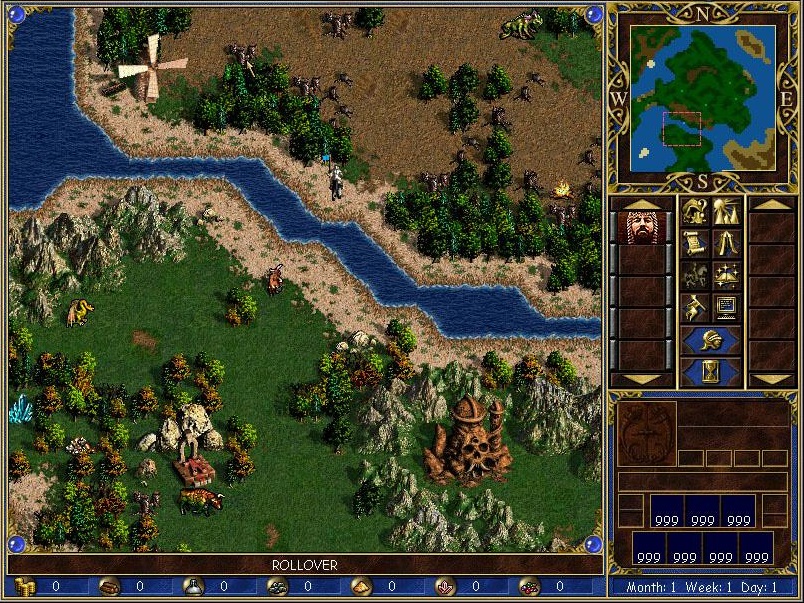
Adventure map beta screenshot
RP: Do you consider the decision to set Command and Conquer: Renegade during the time of the original Command and Conquer, rather than Tiberian Sun, to have been the right one?
GF: While this specific lore decision was made before I joined the team, I agreed with it. We were attempting to tell the story of the original C&C ‘Commando’, so it was only logical to set the story amidst Tiberian Dawn, which was also a massive seller. Tiberian Sun was never seriously considered.
RP: Ubisoft recently announced a remake of Heroes 3. I assume they did not involve you in its development?
GF: I was not involved in its development.
RP: Did the announcement surprise you?
GF: No. After Fanstratics collapsed, Ubisoft reached out, and we had an online meeting. They told me they were remaking HoMM3 and showed me a presentation of what they had done.
RP: If you were in charge of the remake, what would you change in the original game and what would you leave as is?
GF: This it too big of a question to answer in this format.

Dungeon beta screenshot
RP: Do I understand it correct: it sounds like you would change lots of things, doesn’t it?
GF: To a degree, yes, I would make a lot of changes, but this does not necessarily mean the changes would be major. Attention to detail is what separates good from excellent, and excellent from great.
RP: Olden Era and the Heroes 3 remake take place on the planet Enroth, the games look more familiar than Heroes 6 or 7, and the titles are once again traditional (rather than “Might and Magic: Heroes”). Do you think this can be considered a definitive turn by Ubisoft back toward the classic NWC-era games, or are these just one-off projects?
GF: We’ll see. It does seem like they are attempting to press the ‘reset’ button.
RP: How do you feel about the destruction of Enroth between the events of Heroes 3 and 4? Ubisoft now has the opportunity to rewrite the game’s history (a prologue and epilogue have already been announced).
GF: I wasn’t happy with the decision, but I understand it. At the time, the team wanted to move away from Erathia, much in the same way I moved away from Enroth (HoMM2). Still, they could have ‘discovered’ another continent. Destroying the entire planet was puzzling.
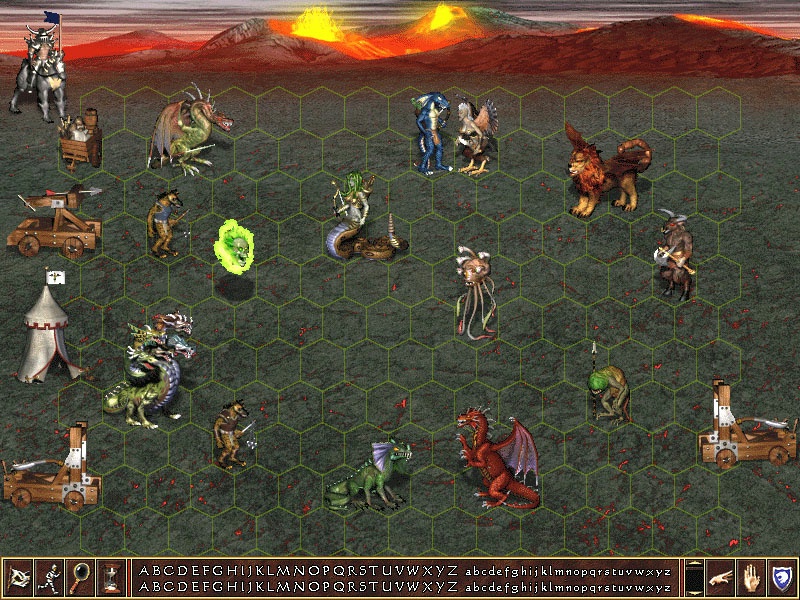
Battle beta screenshot
RP: Do you think they should somehow undo or alter that fatal plot turn for Enroth so that hypothetical future games in the series could once again take place in the world that fans love most?
GF: They could. There are plenty of lore options to sideline the HoMM4 narrative, and continue telling the story of Erathia or Enroth. It would also make a lot of sense, as the characters and the world are well established.
RP: Your recollections about the development of Heroes 3 made for very engaging reading. Now you are preparing a full book. Will it contain new material and topics?
GF: Yes. It will touch upon HoMM3 going gold, the creation and cancellation of Armageddon’s Blade, my leaving NWC, what happened with HoMM3 after I left, and where everything sits at the present time.
RP: Will you go into more detail about your career in the game industry before and after New World Computing?
GF: I do touch upon it, but very lightly. My goal is to limit the scope of my recollections to HoMM3-related subjects.
RP: Roughly when can we expect the book to be released?
GF: Hopefully, sometime in 2027 (fingers crossed).
Greg Fulton is writing a book about the development of Heroes III
Source: https://riotpixels.com/heroes-3-interview/
Heroes III Griffin shield badge in stock

WoG Folder – All HoMM mods in one place