How Magic works in HoMM: Olden Era
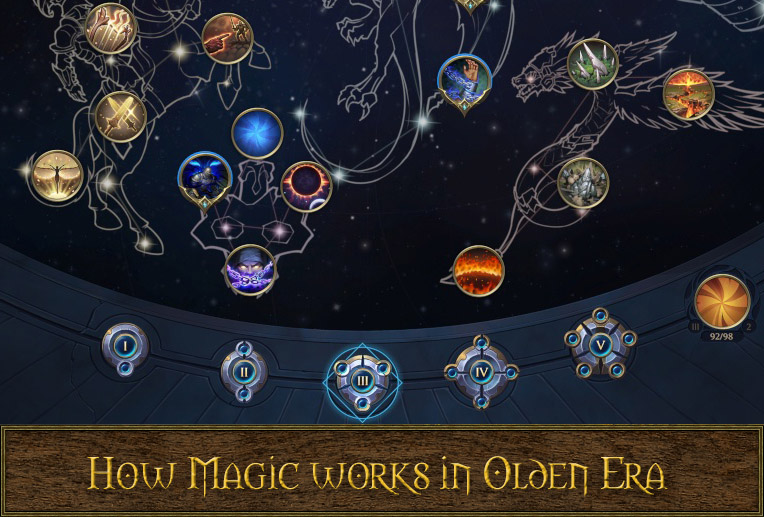
This great article about Olden Era magic system is from Reddit and was created by redditor tpbug, with whose permission I am adding it in its original form.
Leading into the early access for Olden Era, I wanted to share what I’ve learned about Magic in Olden Era (as some of it can be confusing or different from the outdated demo).
The Basics of Magic:
Magic Schools, Mana and Attributes:
- Generally speaking Daylight is buffs, Nightshade is debuffs, Primal is Damage, Arcane is Control.
- Heroes that begin their turn in a town with a mage guild fully restore their mana. Otherwise, heroes gain 10% of their maximum mana pool while out in the field at the start of a day.
- Two of the four hero attributes are associated with spells: Knowledge (gives 10 max mana per point) and Spell Power (generally affects spell duration and strength per point-hold “shift” on a specific spell to check its “Spell Power” scaling if applicable).
Kingdom Spell Management: Observatory, Mage Guilds and Spellbooks:
The “Observatory” interface is your kingdom’s spells. A mage guild is a town’s spells. A spellbook is a hero’s spells. When a hero visits a town, they will try to learn all possible spells if they can based on your kingdom’s Observatory and their ability to learn a magic schools spells and specific tiers within that magic school.
Magic School Tiers and Magic Spell Levels:
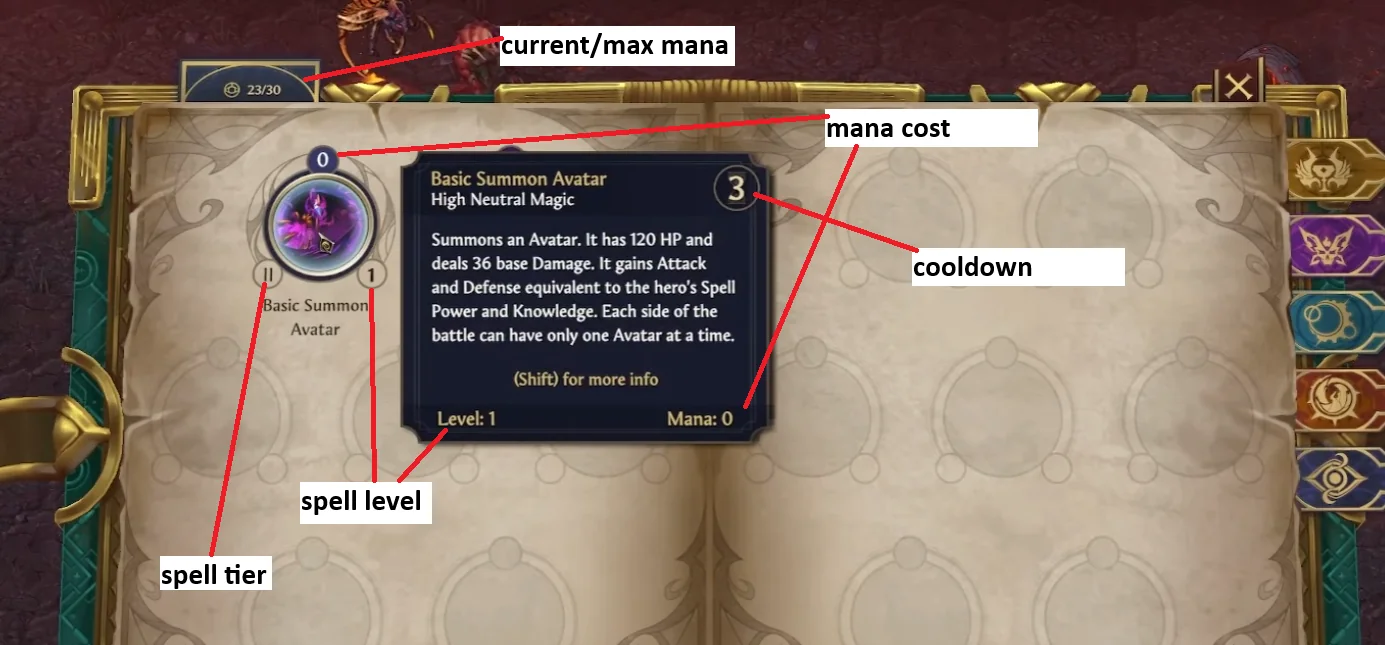
- Magic School Tiers and Magic Spell Levels: Tiers and Levels are not the same. A spell’s tier represents those that are often more difficult for a hero to learn and gates specific spells. However, they are often more powerful. A spell’s level represents a change in that specific spell’s effectiveness.
- Magic School Tiers: All heroes can learn spells from all magic school tiers 1-2 by default. The hero skill “Wisdom” will grant tiers 3/4/5 based on Basic/Advanced/Expert magic school proficiency, respectively. Otherwise, simply knowing a magic school skill (e.g. Nightshade) at Basic proficiency will allow for any spells to be learned from that school.
- Magic Spell Levels: Spells start at level 1 and can be improved up to level 4. Each spell has a different effect based on its level (hold “shift” over a spell tooltip to check).
- Example: Level 1 might have a single target effect, while Level 4 might cast the same effect on all creatures.
How Mage Guild work:
-
- How Mage Guilds Work: Building a Mage Guild in a town will add a random (and set amount) of spells to your kingdom’s Observatory.
- Mage Guild (LvL1) gives an assortment of tier 1 spells. Mage Guild (LvL2) an assortment of tier 2 spells, etc.
- If two different towns both build a Mage Guild (LvL1), two results may occur: either the randomly given tier 1 spells are unlocked (if not known) OR an already known spell in tier 1 is upgraded to the next level. This means constructing multiple mage guilds across different towns not only unlocks spells, but also can upgrade them in your Observatory.
- How Mage Guilds Work: Building a Mage Guild in a town will add a random (and set amount) of spells to your kingdom’s Observatory.
 Unlocking spells
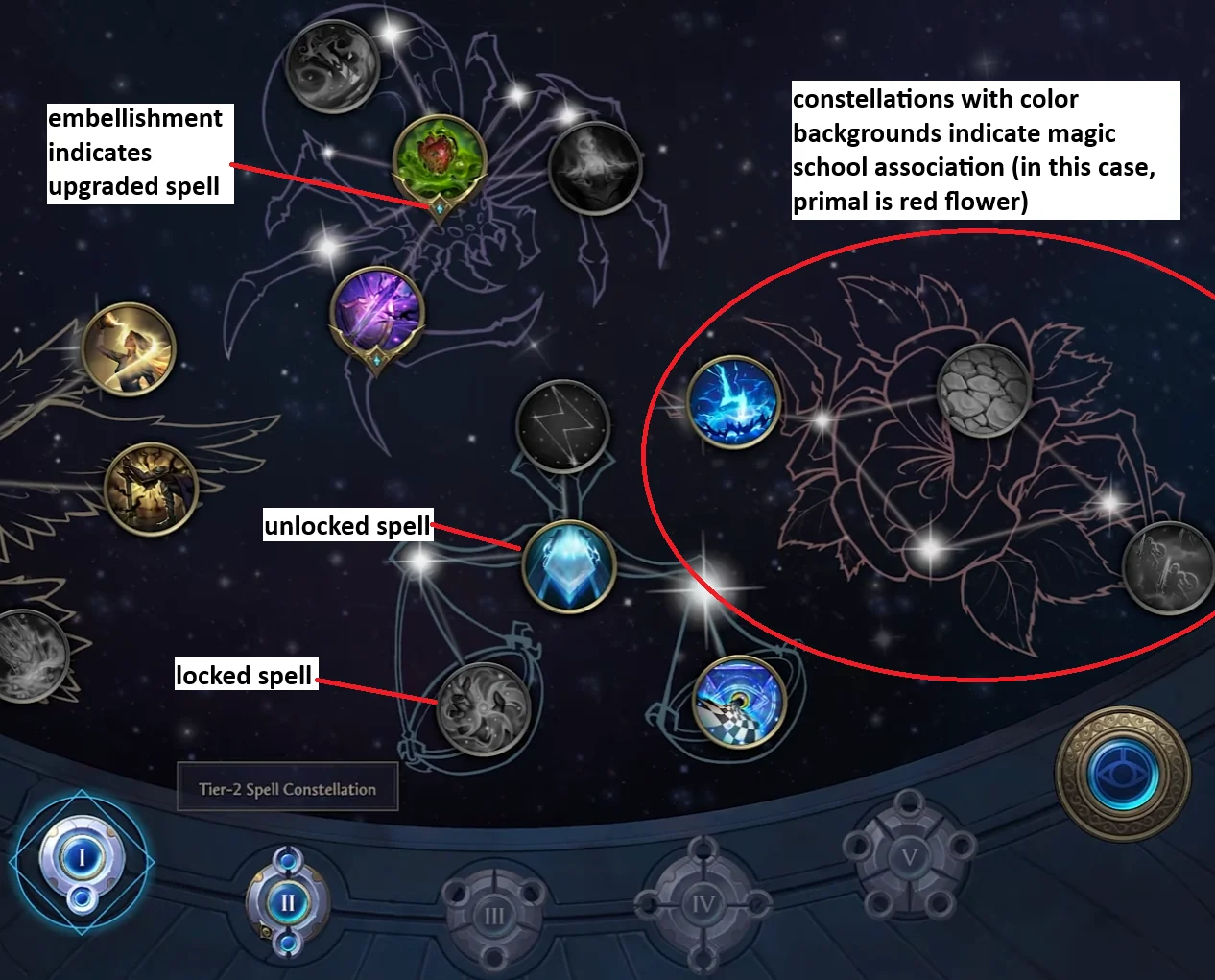
- Manual Spell Unlocks and Upgrades in Observatory: When viewing your Observatory, you can unlock spells with valuable resources (e.g. 2 Mercury, 2 Crystals, 2 Gems for a Tier 1 spell). The cost increases based on the tier. You can manually upgrade already known spells (you can only do this once per spell) using the resource “Alchemical Dust”.
- If you upgrade a spell, any heroes that know that spell will immediately benefit even if they are not in a town.
- If you unlock a spell, a hero will need to visit a town to potentially learn it (if capable). Losing a town with a mage guild causes any unlocks or upgrades of spells to be lost based on that mage guild’s addition.
Practical Example (Hero Visits Town to Learn Magic):
A hero with the “Daylight” skill at “Basic” proficiency visits a town. There is a mage guild in this town, so when the hero travels to the town, it tries to learn all magic that this player’s kingdom has unlocked (what is in their “Observatory” interface). This player controls 3 other towns all which have constructed mage guilds. In this case, the player’s hero learns all tier 1-2 spells that all 4 mage guilds across the kingdom have either unlocked or upgraded, but also learns tiers 3, 4 and 5 magic spells that belong to the “Daylight” constellations in the Observatory because they have the Basic “Daylight” skill.
- Heroes Learning Spells via Objects or Items: Sometimes you will get scrolls or visit objects with your hero that grant spells. In most cases, these do not change your Observatory spells. Instead, spells granted in this way only affect the individual hero. So be diligent in knowing if your hero learned a spell via an equipped scroll item or one-time spell inscription into their individual spellbook.
Astrology Points and Global Spells
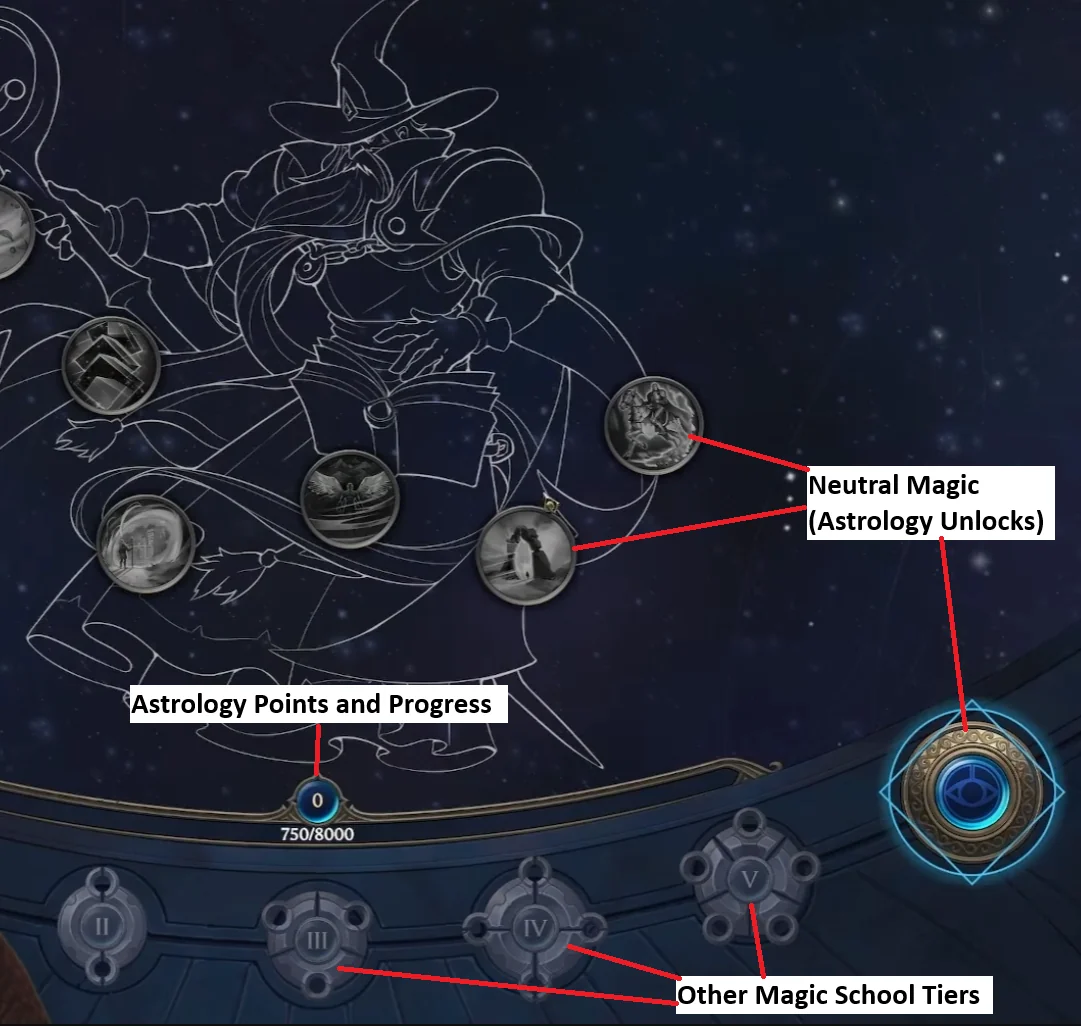
- Astrology Points and Global Spells (different than demo): Most (not all) significant and powerful global map spells are now unlockable via Astrology Points.
- Towns (and sometimes other sources) produce Astrology income.
- Navigate to your “Observatory” interface to unlock Astrology spells with accumulated Astrology points.
- Astrology points can also be used to upgrade these same spells for better effects.
- Unlocked Astrology spells have a level requirement to learn, so make sure your hero is high enough level to get them in your spellbook.
Magic in Combat:
- Magic Usage: In combat (by default), a hero can only cast 1 spell each battle round.
- Cooldowns have been introduced for spells.
- Tier 1 spells have 2 turn cooldowns and each subsequent tier is (in addition to base) +1 turn cooldown. There are artifacts and skills that reduce cooldowns.
- Faction Hero Classes: All factions have hero “classes” (Warlock, Cleric, etc.) based on their unique faction. These hero classes determine the “weight” in which a specific skill might roll when leveling up. This makes each faction’s heroes unique in that they may have a higher proclivity for learning “Primal Magic” skill compared to “Daylight Magic” skill (or other skills like “Logistics”, etc.)
Thaumaturgy:
- Thaumaturgy: Note that only magic hero classes (all factions have “might” and “magic” type hero “classes”) such as a “Warlock” (Dungeon) or “Cleric” (Temple) can learn the skill Thaumaturgy. This allows casting more than 1 spell per battle round but at an increased mana cost.
- Heroes (by default) cannot cast spells from the same magic school (e.g. Arcane) twice with Thaumaturgy. Even if a spell’s cooldown is reduced to technically allow casting it twice in a single battle round, the magic school limitation prevents same spell casting in a single battle round.
- Some unique heroes have a special passive ability that bypasses this limitation.
It is often better to cast a more expensive mana spell first before casting another spell with Thaumaturgy. This is because Thaumaturgy allows casting of more than a single spell in a battle round, but the second spell is more expensive in mana cost.
Miscellaneous:
- Every hero starts with a spellbook regardless of hero class (“Cleric” magic hero class VS “Knight” might hero class for the Temple, etc.). This is different from HOMM3.
- Some towns cannot gain access to Mage Guild (LvL5) and as such must learn Tier 5 spells in some other way.
- Grove and Hive seem to be the most “Primal” magic school focused factions, but this is personal observation.
- You can debuff enemy magic schools quite reliably if you choose that same magic school as a skill. For example, a subskill under higher proficiencies of “Nightshade” magic school reliably include “-1 to enemy’s magic school levels of the same type”.
Disclaimer: I learned them from watching streams and seeing the devs in Twitch chats, etc. They apply to the early access build of the game, but of course some might be subject to change as the game is develops.
I hope someone learned something new!
-by redditor tpbug
Source: https://www.reddit.com/r/OldenEra/comments/1stdsan/how_magic_works_in_olden_era_101_spoilers/
Heroes III Griffin shield badge in stock

WoG Folder – All HoMM mods in one place